Showing posts with label Olympic London Tickets. Show all posts

Saturday, 7 April 2012

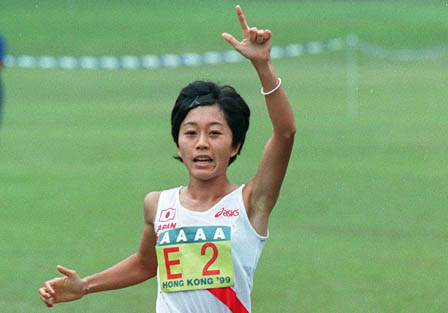
Mizuki Noguchi in 2004 Olympic champion


On 22 August 2004 Noguchi won the marathon in the 2004 Athens Olympics, against a field which included world record holder Paula Radcliffe of Great Britain, and the 2003 world champion Catherine Ndereba of Kenya. The race over the Classic course had begun with temperatures exceeding 95-degree (35°C) and a leading pack of 12 stayed together through halfway in 1 hour 14 minutes. Noguchi made her move on the tough uphill section between the 25-kilometer and 30-kilometer marks. When she reached the 30-kilometer sign, after running the previous 5 kilometers in just under 17 minutes, she had a 26-second lead on Elfenesh Alemu of Ethiopia and a 32-second lead on Radcliffe, Heading into the streets of downtown Athens, Noguchi held off Catherine Ndereba, who closed the gap over the final 5 kilometers but could not make up the difference. Noguchi won in 2 hours 26 minutes 20 seconds. Ndereba finished 12 seconds behind Noguchi. Deena Kastor of the United States took the bronze at 2:27:20.
Now for Olympic 2012, Olympic Athletics Marathon Tickets are being sold at Sport Ticket Exchange. Sport Ticket Exchange offers you all sorts of Olympic Tickets including Olympic Athletics Marathon Tickets at very cheap prices.

Wednesday, 4 April 2012

Early Carrier of Mizuki Noguchi and Olympic Athletics Marathon


Noguchi was born in Kanagawa, but grew up in Ise in Ise city in Mie. She started competing in track and field during her first year of middle school. While attending Ujiyamada Commercial High School, she entered the national high school track meet and competed in the 3000 m and the long-distance relay.
In 1997 she was hired by Wacoal, a maker of women's clothing, as part of their "Spark Angels" program of sponsored women athletes. However, in October of the following year the director, Nobuyuki Fujita, left over differences with the company. He took with him a coach and a few athletes, including Noguchi. While she was receiving unemployment benefits for a short time, she remained active athletically. In February 1999, Fujita and all his followers were hired by globally, a commodity futures firm.
Noguchi began 1999 by winning individual and team gold at the Asian Cross Country Championships, but after winning the Inuyama half marathon, she was inspired to concentrate her efforts on that event. She was ranked second in the world that year, and in 2001 she won in the all-Japan corporate league. With a string of victories, she became known as "Queen of the Half Marathon". Continuing through the Miyazaki Women's Road Race competition in January 2004, she competed in 24 half marathons, and won 14 of them. Only twice was she beaten by another Japanese athlete.
In March 2002 she entered her first full marathon, the Nagoya International Women's Marathon, and won. In January 2003 she won the Osaka International Women's Marathon with a time of 2 hours 21 minutes 18 seconds, the second-fastest on record for Japan. She also won a silver medal in the World Championships in Paris that year. The only point which is trust able for purchasing of Olympic Athletics Marathon Tickets is Sport Ticket Exchange. You can buy Olympic Tickets especially Olympic Athletics Marathon Tickets from Sport Ticket Exchange at cheap rates.

Friday, 30 December 2011

Athletics Marathon at 1908 Summer Olympics


The standard distance for the marathon race was set by the International Amateur Athletic Federation (IAAF) in May 1921 at a distance of 42.195 kilometers. Rule 240 of their Competition Rules specifies the metric version of this distance. This seemingly arbitrary distance was that adopted for the marathon at the 1908 Summer Olympics in London. At a meeting of the International Olympic Committee in The Hague in May 1907 it was agreed with the British Olympic Association that the 1908 Olympics would include a marathon of about 25 miles or 40 kilometers. In November 1907 a route of about that distance was published in the newspapers, starting at Windsor Castle and finishing at the Olympic Stadium, the Great White City Stadium in Shepherd's Bush in London.
 There were protests about the final few miles because of tram-lines and cobbles, so the route was revised to cross the rough ground of Wormwood Scrubs. This lengthened the route, as did plans to make the start 700 yards from Queen Victoria's statue by Windsor Castle, and it was decided to fix the distance at 26 miles to the stadium, plus a lap of the track, using the Royal Entrance as the marathon tunnel, and finishing in front of the Royal Box. For the official Trial Marathon on 25 April 1908, organized by the Polytechnic Harriers, the start was on ‘The Long Walk’ a magnificent avenue leading up to Windsor Castle in the grounds of Windsor Great Park. For the Olympic Marathon itself the start was on the private East Terrace of Windsor Castle, with the permission of King Edward VII, so that the public would not interfere with the start.
 The Princess of Wales and her children drove from their home at Frogmore on the far side of Windsor Great Park to watch the start of the race. Shortly before the Games opened it was realized that the Royal Entrance could not be used as the marathon entrance it was raised to permit easy descent by the royal party from their carriages, and did not open onto the track so an alternative entrance was chosen, diagonally opposite the Royal Box. A special path was made just outside the Franco British Exhibition ground so that the distance to the stadium remained 26 miles.
 The finishing line was left unchanged, but in order that the spectators, including Queen Alexandra, could have the best view of the final yards, the direction of running was changed to "right-hand inside". This meant the distance in the stadium was shortened to 385 yards, and the total distance became 26 miles 385 yards. The only point which is trustable for purchasing of Athletics Marathon Tickets is Sport Ticket Exchange. You can buy any of Olympic Tickets especially Athletics Marathon Tickets from Sport Ticket Exchange at cheap rates.

Thursday, 29 December 2011

Athletics Marathon in Olympic History


When the idea of a modern Olympics became a reality at the end of the 19th century, the initiators and organizers were looking for a great popularizing event, recalling the ancient glory of Greece. The idea of organizing a marathon race came from Michel Breal, who wanted the event to feature in the first modern Olympic Games in 1896 in Athens. This idea was heavily supported by Pierre de Coubertin, the founder of the modern Olympics, as well as the Greeks. The Greeks staged a selection race for the Olympic marathon on 10 March 1896 that was won by Charilaos Vasilakos in 3 hours and 18 minutes. The winner of the first Olympic Marathon, on 10 April 1896, was Spyridon "Spyros" Louis, a Greek water-carrier. He won at the Olympics in 2 hours 58 minutes and 50 seconds.
The women's marathon was introduced at the 1984 Summer Olympics and was won by Joan Benoit of the United States with a time of 2 hours 24 minutes and 52 seconds.
Since the modern games were founded, it has become a tradition for the men's Olympic marathon to be the last event of the athletics calendar, with a finish inside the Olympic stadium, often within hours of, or even incorporated into, the closing ceremonies. The marathon of the 2004 Summer Olympics revived the traditional route from Marathon to Athens, ending at Panathinaiko Stadium, the venue for the 1896 Summer Olympics.
The Olympic men's record is 2:06:32, set at the 2008 Summer Olympics by Samuel Kamau Wanjiru of Kenya. The Olympic women's record is 2:23:14, set at the 2000 Summer Olympics by Naoko Takahashi of Japan. Now for Olympic 2012, Olympic Athletics Marathon Tickets are being sold at Sport Ticket Exchange. Sport Ticket Exchange offers you all sorts of Olympic Tickets including Olympic Athletics Marathon Tickets at very cheap prices.